The key to resilient architecture is not trying to avoid these trade-offs, but choosing them consciously. This is precisely what the CAP Theorem forces us to do.
Understanding CAP Theorem
CAP Theorem states that a distributed system can guarantee only two out of the three properties at the same time:Consistency (C) – Every read returns the most recent write, as if the system were a single machine.
Availability (A) – The system always returns a response, even if some nodes are down.
Partition Tolerance (P) – The system continues operating even when communication between nodes is lost or delayed.
In practice, Partition Tolerance is non-negotiable because network failures are inevitable. This means designers must choose between strong consistency or high availability whenever a partition occurs. CAP is not a math puzzle—it's a business decision.
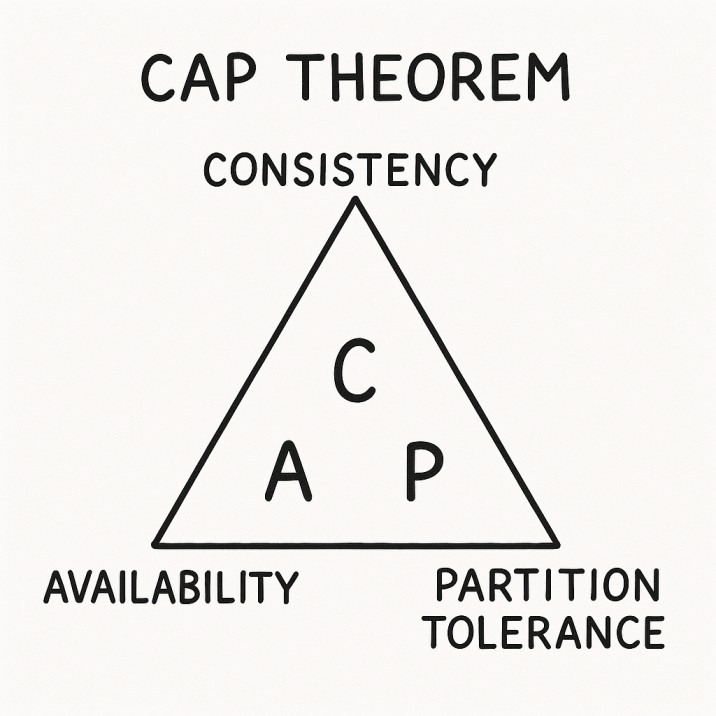
Consistency vs Availability Under Network Partition
The essence of CAP is about behavior during failure. If a network break splits a cluster into two halves, a system that chooses Consistency over Availability will reject requests until replicas can synchronize safely.A system that chooses Availability over Consistency will continue serving reads and writes, even if the data is temporarily stale. Both choices are correct depending on what the business needs.
The question is not "How do we get all three?"" — it's "What is safe to sacrifice for our users?"
Example: Inventory vs. Product Catalog
Inventory (CP Choice)
During checkout, when a customer buys the last pair of shoes, the system cannot risk overselling simply to stay highly available. If replicas are partitioned, the system must reject new orders temporarily rather than sell out-of-stock products.Inventory services usually adopt CP guarantees, they favor Consistency and Partition Tolerance over availability. A short delay or retry is safer than selling nonexistent products.
One way to achieve this is, if network lag occurs, a CP inventory system may block or fail the transaction to avoid inconsistent stock. This protects business revenue and avoids costly cancellations or fraud disputes.
Product Catalog (AP Choice)
On the other hand, when a user is browsing product details or search results, the system can tolerate slight staleness. If shoe stock drops from 10 to 8 and a distant replica hasn't updated yet, showing "10 items left" is harmless. Browsing performance matters more than exact accuracy.Therefore, product catalog, recommendations, and reviews frequently choose AP guarantees, they favor Availability and Partition Tolerance over strict consistency.
One way to achieve this is, if network lag occurs, make Users always see results, even if some product details are a few seconds out of date.
This improves user engagement and reduces latency, which directly correlates to conversion.
Payments: Strong Consistency First (CP/Hybrid)
Payments are a hybrid scenario where availability matters, but correctness is non-negotiable. To avoid double charges or lost settlements, most payment systems rely on highly consistent write paths, even if that means failing a transaction occasionally.Many E-commerce platforms treat payments like inventory and choose CP behavior for the transactional write. Later settlement details or ledger analytics can use eventual consistency.
Conclusion
CAP Is About Business Choices, Not Technology.Teams often mistakenly think CAP is about selecting databases. In reality, CAP is a business trade-off. Tools like Cassandra, MongoDB, DynamoDB, Spanner, PostgreSQL clusters all offer tunable consistency levels. The real decision is whether your business can tolerate stale reads or failed writes during network partition.
- For revenue-critical operations (checkout, inventory, payments), you choose Consistency first.
- For high-volume browsing experiences (catalog, search, analytics), you choose Availability first.
CAP isn't a limitation—it's a framework for making those trade-offs responsibly.